
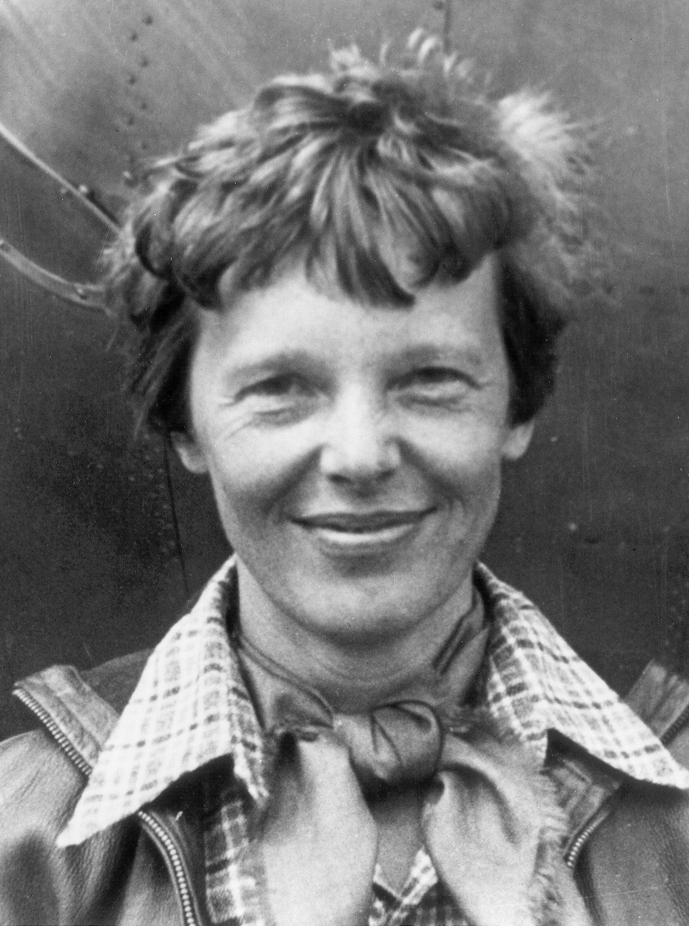
In loving memory of
Amelia Earhart
June 24, 1897
She was a pioneering American aviator who became one of the world's most famous pilots before mysteriously disappearing in 1937.
There's more to life than being a passenger.
Remembering Amelia
A life held close in memory
Amelia Earhart’s childhood was shaped by her adventurous and unconventional spirit, which often defied the strict social expectations for young girls in the early twentieth century. When she was about seven years old, she visited the World’s Fair in St. Louis and became completely fascinated by a roller coaster she saw there. Upon returning home to Atchison, Kansas, she decided to replicate that thrilling experience right in her grandparents' backyard. Along with her sister and an uncle, she constructed a makeshift track out of wooden planks and a meat-cleaver crate, setting up a ramp that ran from the roof of the backyard tool shed all the way down to the ground. Amelia took the very first test run, which ended abruptly with the crate shattering and Amelia landing hard with torn clothes and a bruised lip. Despite the painful crash, she enthusiastically told her sister that the experience felt just like flying, offering an early glimpse into her lifelong passion for speed and danger.
Her daring personality later attracted other influential women, leading to a close bond with First Lady Eleanor Roosevelt in the early 1930s. The two women shared a passionate belief in women's rights, personal independence, and professional career development for females across America. In April 1933, during a formal White House dinner, Amelia and Eleanor managed to sneak away from the party while still dressed in their elegant evening gowns. They drove to a nearby airport and took an impromptu night flight over Washington, D.C., and Baltimore, with Amelia taking the controls while Eleanor watched the city lights in absolute fascination. Inspired by the thrilling experience, Eleanor actually applied for her own student flying permit, though President Franklin D. Roosevelt ultimately discouraged her from pursuing the lessons due to his severe safety concerns.
The adventurous life of this aviation pioneer came to an abrupt end during her final flight, giving rise to three primary disappearance theories that continue to dominate history today. The first is the crash and sink theory, which serves as the official United States government position on the matter. This scenario suggests that Amelia and her navigator, Fred Noonan, simply ran out of fuel while desperately searching for Howland Island and crashed into the deep Pacific Ocean, causing the heavy aircraft to sink quickly to the sea floor. The second is the castaway theory, which argues that the duo missed their destination but managed to land safely on a flat coral reef near Nikumaroro Island. Proponents of this idea believe they survived as castaways for a short time before ultimately dying of dehydration or severe injury. The third is the capture theory, a more conspiratorial angle suggesting that Amelia and Noonan blew far off course into the Marshall Islands, which were occupied by the Japanese military at the time. This theory claims they were captured, held as international spies, and eventually died in military captivity.
Moments that shaped a life
Life highlights
Amelia is born
Atchison, KS
Takes off for solo flight
Newfoundland
Amelia Vanishes
Pacific Ocean near Howland Island
Shared moments
From the gallery
Words from family and friends
Recent remembrances
To the woman who looked at the horizon and refused to see a boundary.
She set new boundries